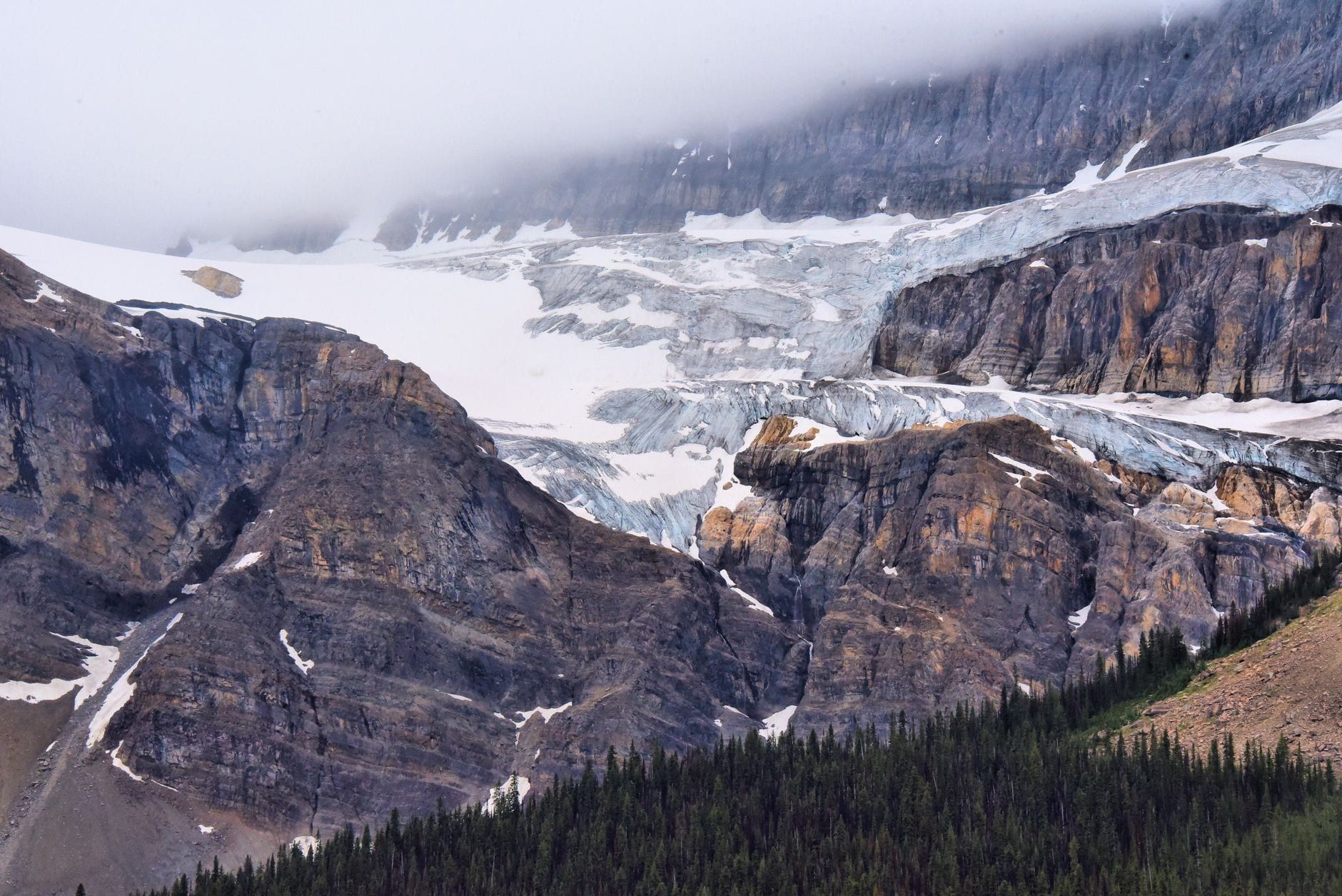
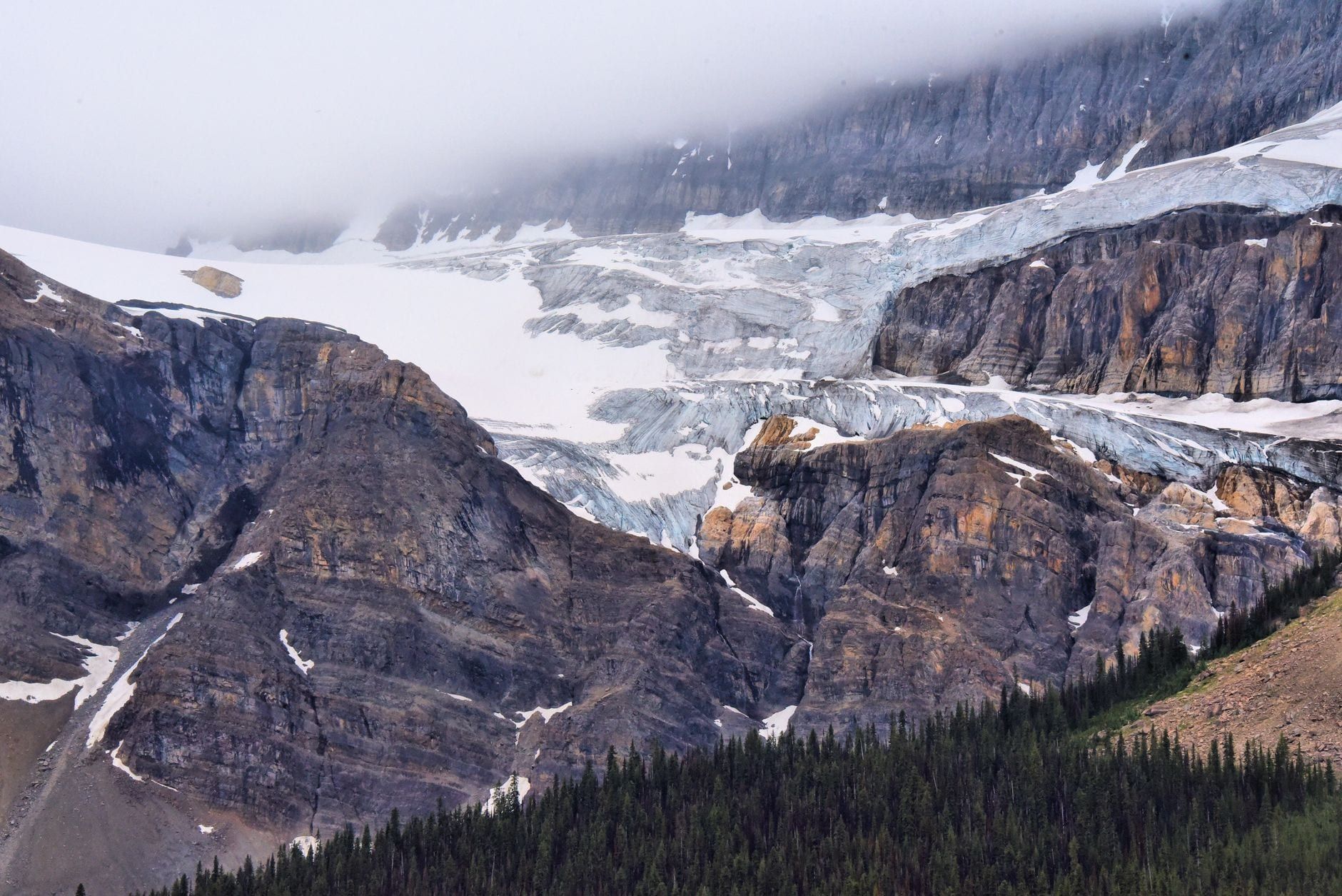
Ski down to the rope line at the Columbia Icefield Glacier Discovery Centre and you've reached the edge of the guided tourist zone. Ski tourers cross that line and keep climbing. The Athabasca Glacier's ski route is an unmarked, glaciated ascent onto the Columbia Icefield plateau, rated ATES Class 3 by Parks Canada for its crevasse bands, icefalls, and overlapping avalanche paths. It's the standard approach for ski mountaineers heading to Snow Dome, Mount Columbia, Mount Andromeda, and other summits on the icefield, not a groomed run or a summer glacier walk with crampons handed out at the door.
This guide covers the route itself, the season window, the hazards that have injured and killed skiers on this exact glacier, and the gear and training you need before you rope up. If you're picturing the summer Ice Explorer and Skywalk experience, this is a different activity entirely, and it demands its own planning.
What 'Athabasca Glacier ski touring' actually means
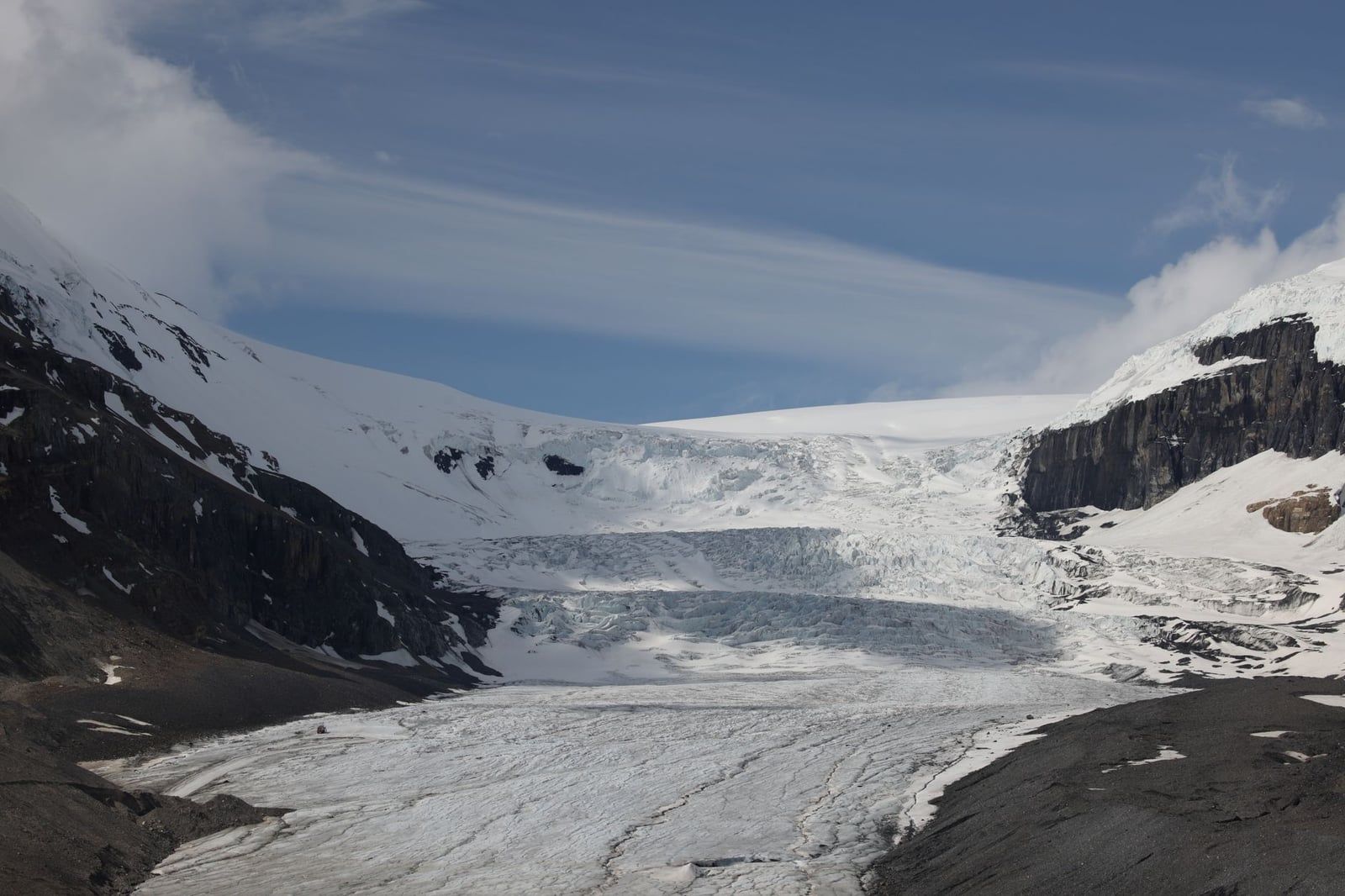
Skiing the Athabasca Glacier means skinning up its surface from the valley floor to gain the Columbia Icefield, an approach route rather than a destination in itself. Parks Canada classifies it ATES Class 3: complicated glacier travel with extensive crevasse bands, icefalls, and avalanche paths that overlap the ascent line. That's well above the Class 1-2 zones most weekend tourers are used to.
Guides call the standard line the Athabasca Ramp: skirt climber's right around the first icefall, cut back left through the second, then follow the final ramp onto the plateau. None of it is marked, patrolled, or groomed. Every party makes its own route-finding calls through crevasse terrain that looks identical in a whiteout.
This bears no resemblance to the summer scene at the glacier's toe, where roped-off walkways, the Glacier Skywalk, and short guided glacier walks keep visitors on a fenced, monitored patch of ice for twenty minutes. Ski tourers travel independently through active crevasse terrain, often before dawn, aiming for a summit hours away.
This is intermediate-to-advanced terrain. You need glacier travel experience and crevasse rescue skills, not just strong ski legs. Reach the top and the icefield opens onto Snow Dome, Mount Columbia, Mount Andromeda, Mount Kitchener, and flatter link-up terrain toward Castleguard Meadows, a plateau of options that makes the Athabasca Ramp one of the busiest serious approach routes in the range.
Season and conditions: when to go
December and January are usually the wrong months. Parks Canada describes the early-season snowpack on the icefield and surrounding peaks as typically weak and unstable, prone to the kind of persistent weak layers that trigger large avalanches. Going anyway means gambling on a base that hasn't consolidated yet.
Stability generally improves by mid-February, though that's also when some of the biggest avalanches of the season release as the snowpack adjusts. Parks Canada recommends the alpine touring season on the icefield and surrounding 11,000ers runs from February through April or May, once there's enough coverage to bridge crevasses and enough daylight for a full ascent and descent.
Conditions still swing hard between snow years. An April 1 patrol by Jasper Visitor Safety, in an above-average year, probed depths mostly over 3 metres along the ascent line, with a thin spot of just 1.5 metres near the top of the second icefall — thin enough to expose a crevasse lip. The same patrol logged active seracs and a 3-metre avalanche crown near Snowdome. In a lean year, expect more bare ice, more visible cracks, and a route that looks nothing like last season's trip reports.
Getting there has its own friction in winter. The Icefields Parkway runs through numerous marked avalanche paths where stopping or parking is banned outright, and Parks Canada's avalanche control program can close the road for days at a stretch. Check conditions the morning you drive, not the night before.
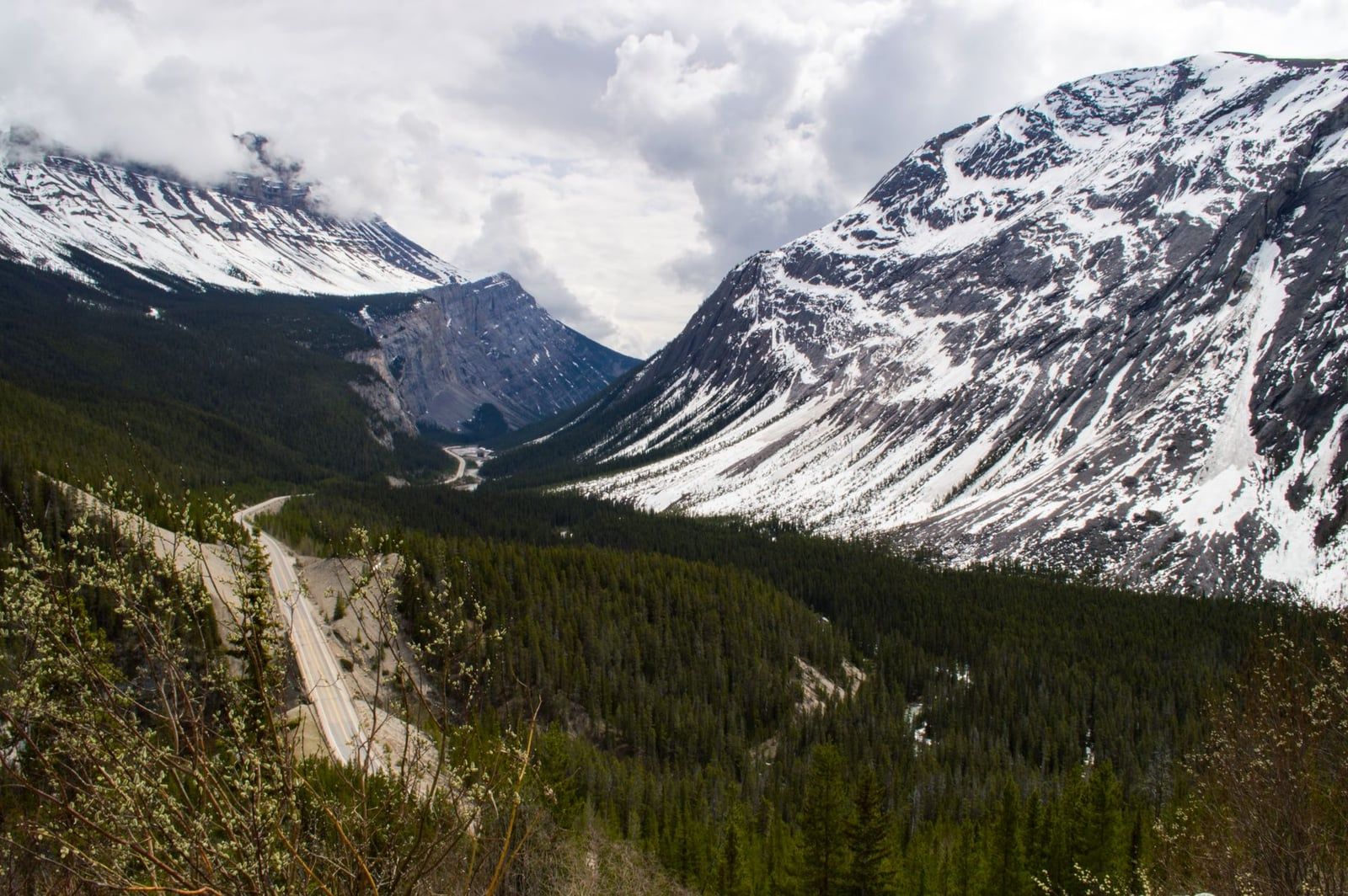
The route up: from the toe of the glacier to the icefield
Most parties start from the same lower parking area used by summer glacier visitors, at the toe of the Athabasca Glacier off the Icefields Parkway. When the snowcoach road sits unused under snow, it often doubles as the first stretch of the skin track before the route bends onto the ice itself.
From there, the route crosses three crevasse bands stacked like broken stair steps. The standard line skirts climber's right around the first icefall, swings back climber's left through the second, then gains the final ramp, the long moderate-angle slope that gives the route its name, onto the icefield plateau. Route-finding through the bands shifts season to season as crevasses open and close with the ice's flow.
Snowdome rises on climber's right for most of the ascent, and its serac band has a documented history of releasing without warning. Parties generally give that side of the valley a wide berth rather than shortcutting close to the icefall for a faster line.
One reported ascent to Snow Dome took about 6 hours up and 2 hours down from the glacier toe, following the graded lower section before angling across to the north side past the three crevasse bands. The ski back down the ramp, in good corn or wind-buffed snow, is the payoff: a long, sustained descent rather than a short lap.
The icefield itself is close to featureless — a broad, white plateau at roughly 1,900 to 2,800 metres with none of the visual reference points you'd rely on lower down. A GPS and a compass bearing matter more here than terrain reading, especially if cloud rolls in.
Popular ski objectives reached from the icefield
Four objectives account for most of the traffic off the top of the Athabasca Ramp, and they're not interchangeable in difficulty or commitment.
| Objective | Elevation | Round-trip time | Ski difficulty |
|---|---|---|---|
| Snow Dome | 3,451 m | 1 long day (~8 hrs from glacier toe) | Moderate glacier tour |
| Mount Columbia | 3,747 m | 3-4 days with camping | Ski mountaineering, steep snow to 40° |
| Mount Andromeda | 3,450 m | 1-2 days | Advanced, single black diamond minimum |
| Mount Kitchener | — | 2-3 days, often with camping | Multi-day, moderate to advanced |
Snow Dome (3,451 m)
Snow Dome is the most approachable summit off the icefield, though approachable is relative to Mount Columbia next door. It marks one of the hydrological apexes of North America: meltwater off its slopes runs to the Atlantic, Arctic, and Pacific via the North Saskatchewan, Athabasca, and Columbia rivers, a three-ocean divide most skiers only appreciate on the drive home. The summit is broad and deceptive, with false summits that fool tired parties into stopping short. Descend the way you came, back down the ramp, for one of the longer sustained glacier ski runs in the range.
Mount Columbia (3,747 m)
Mount Columbia is Alberta's highest peak, and it's a multi-day expedition, not a long day out. Guided ascents pitch a camp in a sheltered basin known as the Trench, then climb the East Face on steep snow up to 40 degrees before dropping back onto the icefield, with roughly 800 metres of elevation gain per day and a possible Snowdome ski descent on the way out. This is the objective that separates strong ski tourers from ski mountaineers — go with a guide, or a team that has run a comparable glacier expedition before.
Mount Andromeda (3,450 m)
Mount Andromeda draws skiers for its descent as much as its summit: guided trips cover close to 1,600 metres of vertical, nearly all of it above the icefield. Operators set the bar at single black diamond skiing with prior ski mountaineering experience, and that's a fair minimum since the exposure and firm snow near the top punish anyone still working on their turns. Done in a single long day or split over two, it rewards technical skiers more than strong hikers on skis.
Mount Kitchener
Mount Kitchener is the low-key, multi-day option of the four, historically used for winter camping trips that pitch an igloo or snow shelter on the icefield rather than push a technical summit in a day. It's less about a hard objective and more about a night or two out on the ice, which is its own reward when the weather holds.
Hazards: crevasses, seracs, and avalanches
Crevasses are the defining hazard, and snow cover makes them worse, not better. A bridge that looks solid can be a metre of unsupported snow over open ice, with no way to tell from the surface. Unroped travel across the icefield's crevassed sections is a bet nobody can quote you the odds on.
That bet doesn't always pay off. On May 12, 2025, a 38-year-old man died after falling roughly 25 metres into a crevasse on the Athabasca Glacier while backcountry skiing with two friends. Weather and the remoteness of the site delayed recovery of his body for two days. It's a stark, recent reminder that this glacier injures experienced recreational skiers, not just tourists who wander off a marked path.
It isn't a new problem. A 1984 incident on the Columbia Icefield involved a party of four who fell into a crevasse after being told, wrongly, that local crevasses would be filled in with snow. Snow fills gaps. It doesn't make them load-bearing.
Snowdome's serac band overhangs part of the standard route on climber's right, an ongoing icefall hazard rather than a one-off event. Add avalanche terrain along the approach slopes and the icefield's edges, and you've got three separate hazard types stacked on the same few kilometres of ground: crevasses, ice fall, and slide paths, all active in the same season.
None of this is a reason to stay home if you're qualified. It's a reason to rope up, carry a rescue kit, and know how to use it before you're the one standing at the lip of a hole your partner just vanished into. Parks Canada is blunt about it: don't go onto glaciated terrain unless everyone in the group is equipped and trained for glacier travel, crevasse rescue, and whiteout navigation.
Skills, fitness, and gear you need
Solid kick turns and clean transitions matter more here than powder technique, since most of the skiing is on firm, wind-affected, or variable glacier snow. Add glacier travel skills to that list: roping up correctly, reading crevasse patterns, and running a rescue with a pulley system practiced beforehand, not improvised on the ice.
Multi-day objectives like Mount Columbia ask for packs up to 25 kg (55 lb), travel days of 10 kilometres or more, and up to 800 metres of elevation gain in a single push. That's expedition-level fitness, not a fit weekend hiker's baseline.
- AT skis or a splitboard, plus ski crampons for firm sections
- Glacier kit: lightweight harness, carabiners, cordelette, sewn sling, ice screw, aluminum ice axe
- Avalanche transceiver (3-antenna), a probe of 240 cm or longer, metal-blade shovel
- Team rope, map, compass or GPS, and an altimeter for whiteout navigation
Take an Avalanche Skills Training course (AST 1, then AST 2) and a dedicated glacier travel and crevasse rescue course before attempting this independently. A day of instruction is far cheaper than learning rescue technique for the first time mid-rescue. If your group doesn't have that background yet, hiring an ACMG or IFMGA-certified guide for a first icefield objective is the sensible move, not a shortcut.
Permits, access, and guided options
A Jasper National Park pass is required simply to drive the Icefields Parkway and park at the glacier, at CA $12.25 per adult per day, available online through Parks Canada or at the gate — current rates are posted on our hours and fees page. There's no separate ski-touring permit, though overnight backcountry camping may carry its own wilderness fee for multi-day objectives.
Search and rescue is free for active pass holders if things go wrong, which matters given the terrain. What it typically doesn't cover is the ambulance or evacuation bill afterward, so check your insurance before you head out, not after.
The trailhead sits right off Highway 93, about 108 km (roughly an hour's drive) south of Jasper townsite, or around 180 km (2.5 hours) north of Banff via Lake Louise. Check the full driving directions before staging from either town, since both routes close occasionally for avalanche control in winter.
From November to mid-May, Parks Canada closes access to occupied caribou ranges elsewhere in Jasper National Park, to stop packed ski tracks from giving wolves an easy route into critical winter caribou habitat. It doesn't block the Athabasca Ramp itself, but it does affect some nearby approach options, so check current closures before committing to a line.
A guided multi-day Mount Columbia ski expedition runs around $1,269 CDN plus tax, including a certified guide, meals, group camping gear, and wilderness passes. For a first icefield trip, that's a fair price for the margin of safety an ACMG guide adds on unfamiliar, crevassed terrain.
Alternatives if you're not ready for the icefield
If the hazard section talked you out of it this season, that's the right read for plenty of skiers. Parks Canada lists Parkers Ridge, Destiny Ridge, Nigel Pass and Nigel Basin, and Bald Hills and Shangri-La as ATES Class 1-2 options in the same stretch of the Icefields Parkway corridor, without the glacier travel or crevasse exposure.
Wilcox Pass, right near the Icefield Centre, gives a non-glaciated viewpoint tour with wide-open looks at the Athabasca Glacier from across the valley. No rope, no crampons, no crevasse rescue kit required.
Hilda Ridge and the Boundary Glacier Loop, both close to the icefield, are marketed to newer and experienced backcountry skiers alike, with the Hilda Hut set up for longer stays. Booking a guided day on one of these first is a reasonable way to build the judgment you'll want before ever roping up for the Athabasca Ramp. And if you'd rather see the icefield without any of this risk, guided day trips departing from Banff hotels or downtown Calgary get you to the Discovery Centre without touching a rope.
Frequently asked questions
Can beginners ski tour on the Athabasca Glacier?
No. Parks Canada rates the route ATES Class 3, requiring glacier travel, crevasse rescue, and whiteout navigation skills. Beginners should start on ATES Class 1-2 zones like Bald Hills or Parkers Ridge, or hire an ACMG guide before attempting the icefield.
When is the best time to ski the Athabasca Glacier?
Roughly February through April or May. December-January snowpack is often too weak and unstable, per Parks Canada, and conditions vary by snow year, so check the current avalanche bulletin and recent patrol reports before you go.
Do I need a guide to ski tour the Columbia Icefield?
It isn't legally required, but Parks Canada and every experienced operator recommend it unless the whole party has glacier travel and crevasse rescue training and equipment. Guided multi-day trips run roughly $1,269 CDN and up per person.
How dangerous is skiing the Athabasca Glacier?
It carries real, documented risk. A 38-year-old skier died after falling about 25 metres into a crevasse on May 12, 2025, and Snowdome's active seracs and crevasse bands remain ongoing hazards even for experienced parties.
What can you ski from the top of the Athabasca Glacier?
The Columbia Icefield gives access to Snow Dome (3,451 m), Mount Columbia (3,747 m, Alberta's highest peak), Mount Andromeda (3,450 m), and Mount Kitchener, among other objectives.
Do you need a permit to ski on the Columbia Icefield?
You need a valid Jasper National Park pass. No separate ski-touring permit is required, though wilderness camping fees may apply for overnight trips, and caribou closures from November to mid-May restrict some nearby approach areas.
How long does it take to ski up the Athabasca Glacier?
A day-trip ascent to Snow Dome took about 6 hours up and 2 hours down in one reported climb. Multi-day objectives like Mount Columbia typically take 3-4 days round trip with camping.
What gear do you need for Athabasca Glacier ski touring?
AT skis or a splitboard with ski crampons, a glacier travel kit (harness, rope, carabiners, ice axe), an avalanche transceiver, probe, and shovel, plus winter camping gear for multi-day objectives.