
About All Tours From Banff ToursFrom Calgary ToursGlacier Skywalk ToursAthabasca Glacier Hike Tours Directions Hours & Fees Guides
Find Tours 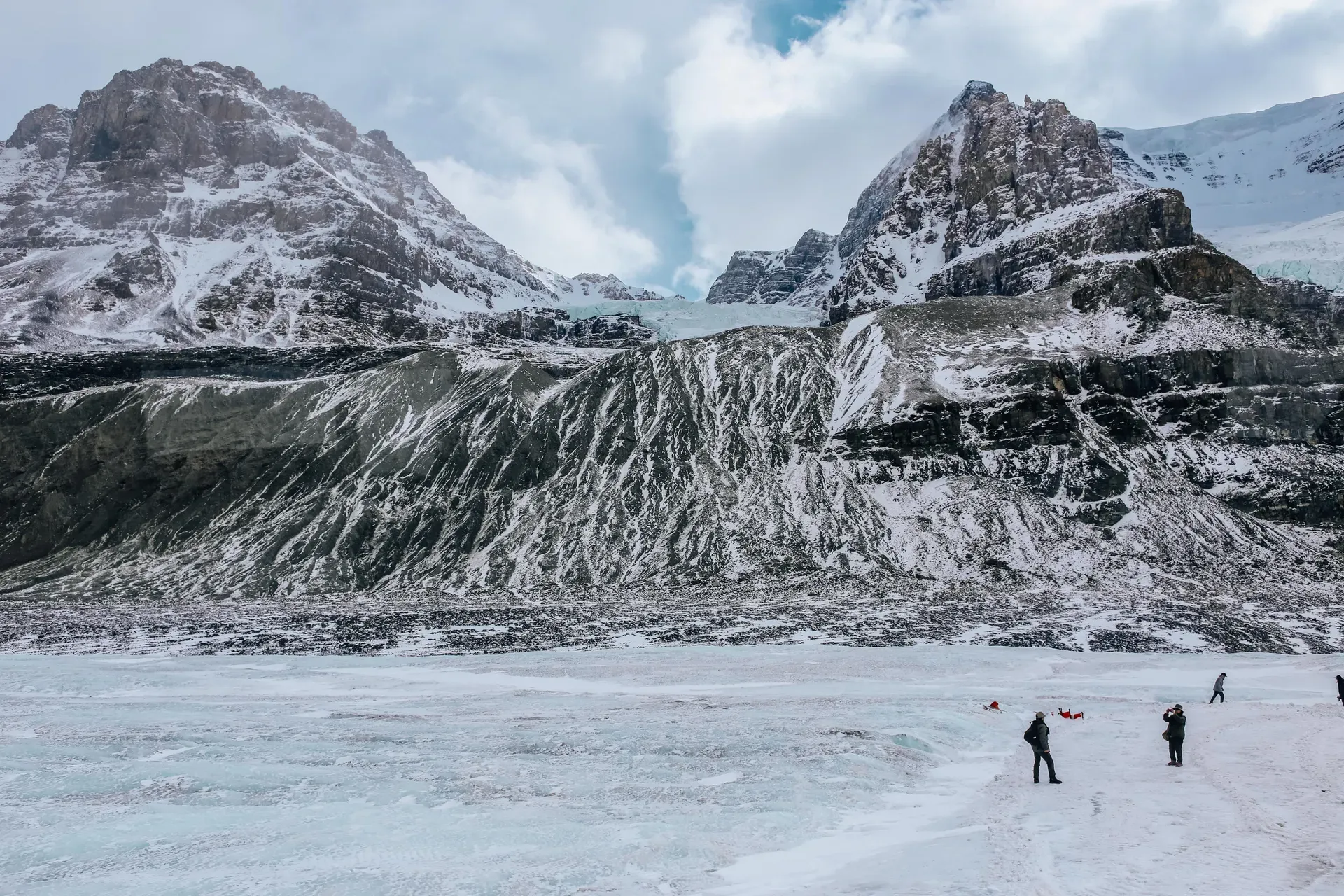
The Columbia Icefield is a 325-square-kilometre expanse of ancient ice straddling the Continental Divide between Banff and Jasper National Parks. Its meltwater feeds three different oceans, making it the hydrographic apex of North America.
The Columbia Icefield spans 325 square kilometres across the high plateau of the Canadian Rockies. It sits exactly on the Continental Divide, straddling the border of Alberta and British Columbia. Meltwater from this massive frozen reservoir flows into rivers that eventually reach the Pacific, Atlantic, and Arctic oceans. Eight major outlet glaciers spill down from the central ice mass. The most accessible is the Athabasca Glacier, descending directly toward the Icefields Parkway.
You'll access the icefield from the Glacier Discovery Centre at Sunwapta Pass, elevation 2,035 metres. From here, massive six-wheel-drive Ice Explorers drive directly onto the Athabasca Glacier. You step out onto ice that is 10,000 years old. The surface is slick, uneven, and runs about 15 degrees Celsius colder than the parking lot. Winds whip down the valley, carrying the sharp smell of crushed rock and freezing rain. The weather shifts from bright sun to blinding snow in minutes.
A few minutes north, the Columbia Icefield Skywalk extends 35 metres out from the cliff face. The glass floor drops your line of sight 280 metres straight down into the Sunwapta Valley. Bighorn sheep often navigate the rocky ledges below. Book a tour departure after 3:30 p.m. to get a 20 percent discount and avoid the heaviest midday crowds.
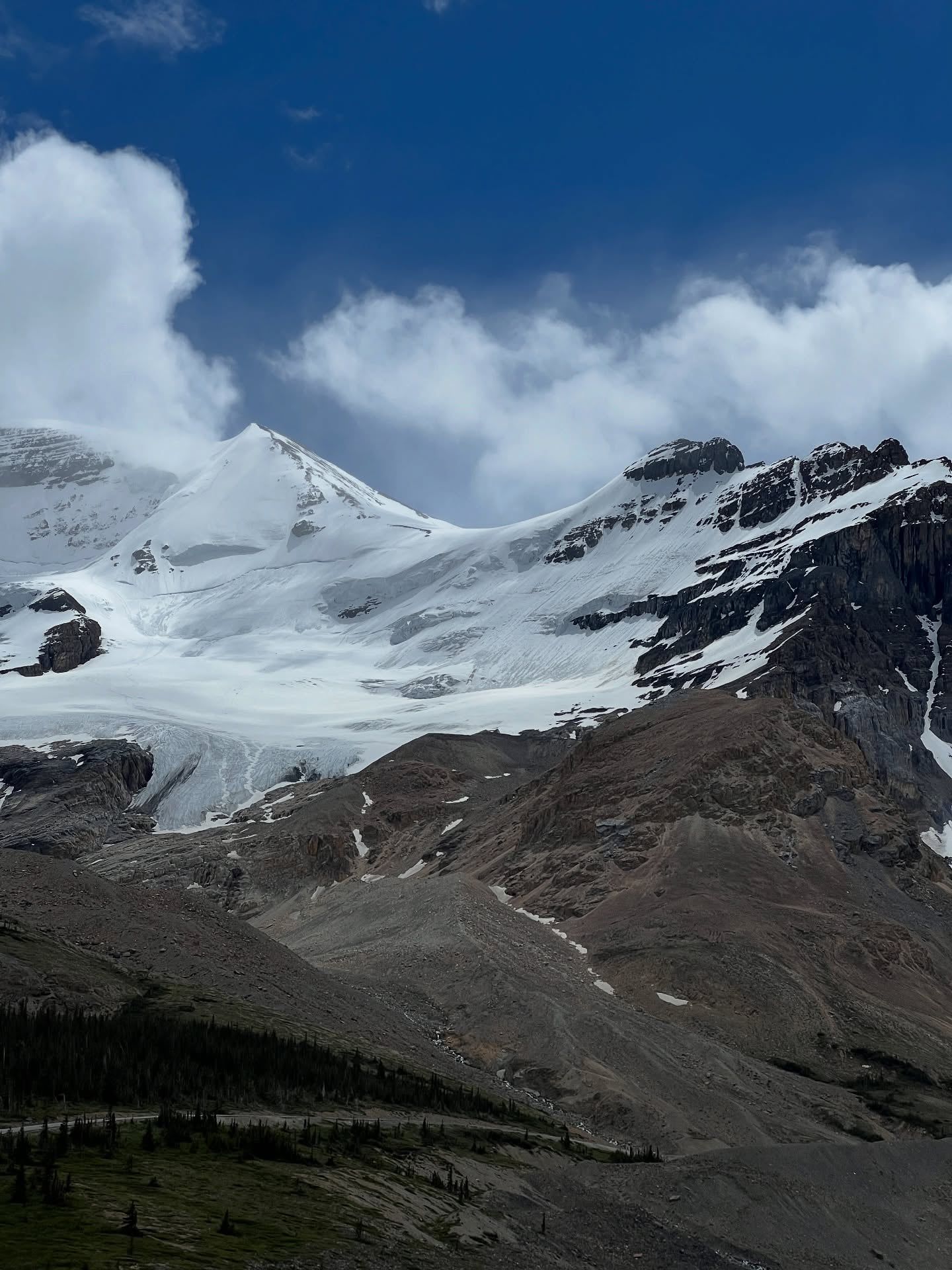
The Columbia Icefield formed during the Great Illinoian Glaciation between 238,000 and 126,000 BCE. A thick sheet of ice covered the high-elevation plateau, grinding the underlying limestone into fine rock flour. The icefield expanded significantly during the Little Ice Age, reaching its most recent maximum extent between 1200 and 1900 AD. The Athabasca Glacier pushed far down the valley during this period. You can still see the massive lateral moraines—mounds of scraped rock and debris—marking the glacier's historic boundaries.
European explorers mapped the surrounding valleys for decades before finding the central ice mass. Geologist Arthur Philemon Coleman scouted the region in 1884. He charted the route that eventually became the Icefields Parkway. The icefield itself remained hidden from European records until 1898. British explorer J. Norman Collie, Hugh Stutfield, and Herman Wooley hired local outfitter Bill Peyto to guide them up Mount Athabasca. From the 3,490-metre summit, they looked west and saw the 325-square-kilometre expanse of ice stretching across the Continental Divide. Between 1900 and 1902, James Outram completed the first ascents of several surrounding peaks, including Mount Columbia.
The Athabasca Glacier has retreated more than 1.5 kilometres since the late 19th century. It loses about five metres of depth every year. Parks Canada tracks this recession with physical markers planted along the valley floor. Visitors walking from the lower parking lot pass signs indicating where the ice edge stood in 1992, 1982, and earlier. The icefield is a highly visible, easily accessible indicator of climate change. Walk the short Toe of the Glacier trail to see the exact current boundary, but stay behind the safety ropes—hidden crevasses near the edge have caused fatal falls.
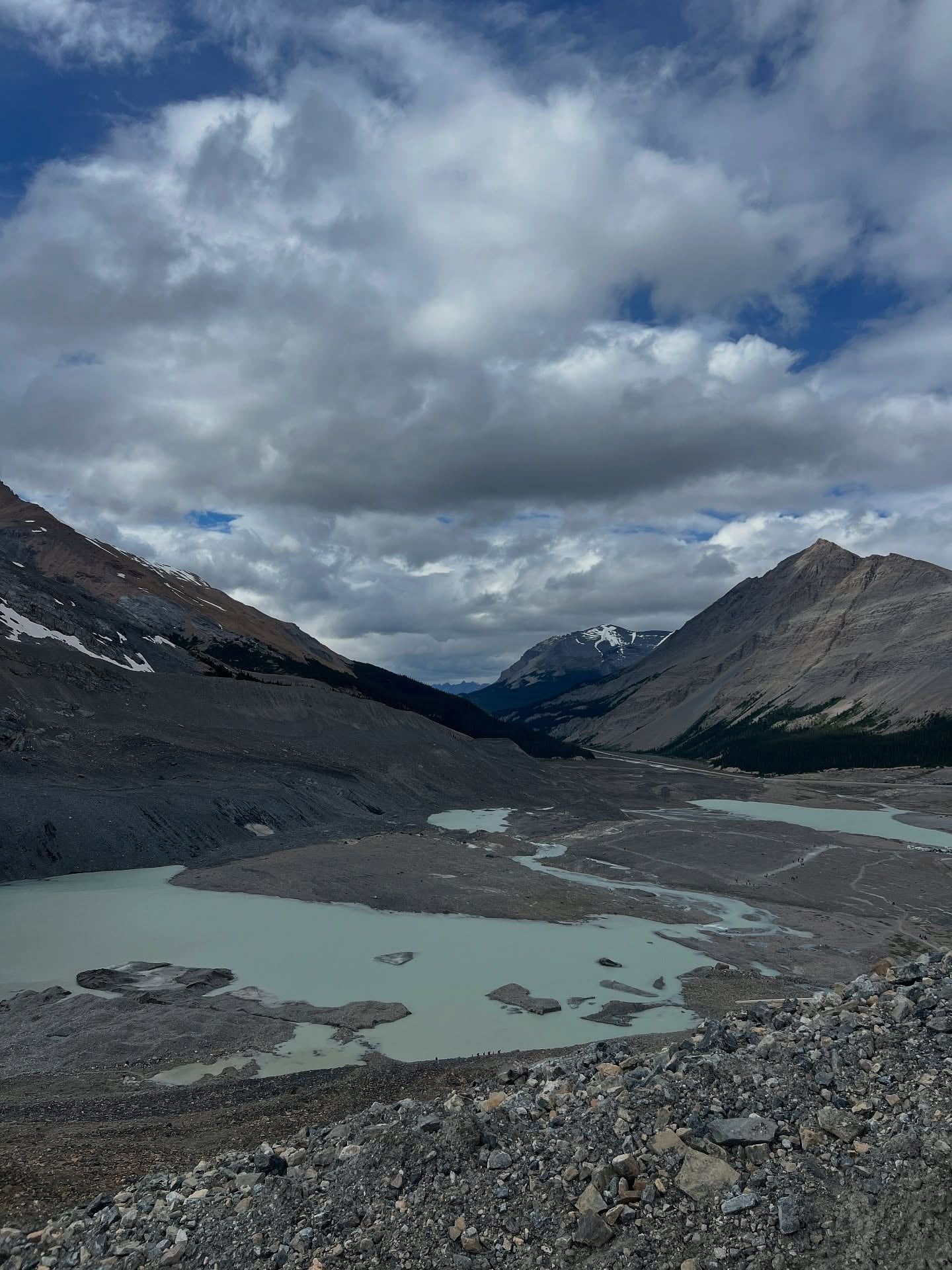
The Columbia Icefield sits on a high-elevation plateau between 1,900 and 2,800 metres above sea level. This altitude catches Pacific moisture moving east across the mountains. The area receives up to seven metres of snowfall annually. Because the summer melt cannot keep pace with the winter accumulation, the snow compresses into solid ice. The icefield reaches depths of 100 to 365 metres. Mount Columbia, the highest point in Alberta at 3,747 metres, anchors the western edge.
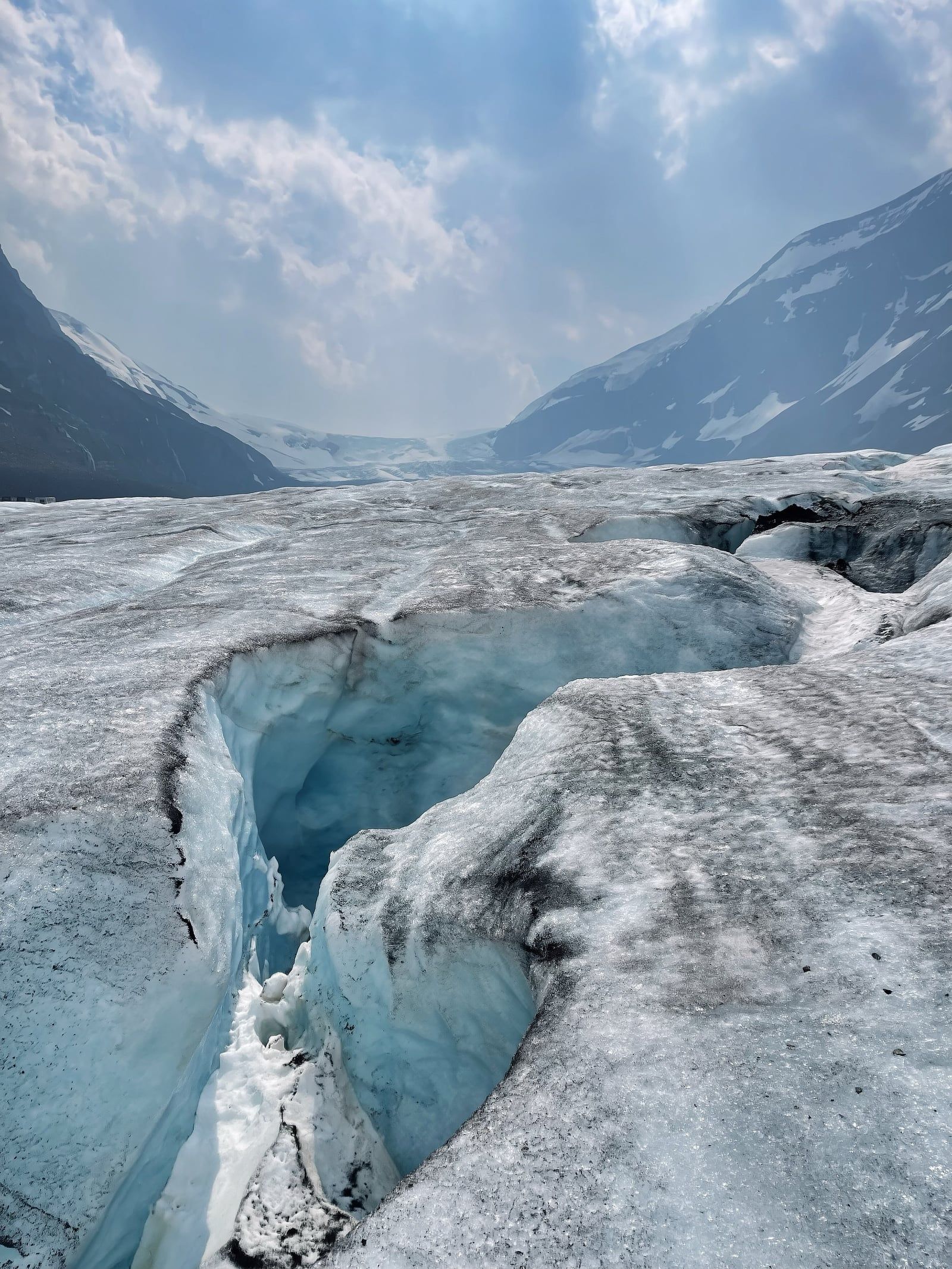
Eight major outlet glaciers flow outward from this central reservoir. The Athabasca Glacier is the most prominent, descending in a steep, fractured tongue toward Highway 93. Its surface is heavily crevassed. Deep cracks open in the ice as it flows over uneven bedrock. Meltwater streams carve bright blue channels across the surface before plunging into vertical shafts called moulins. The water travels through the glacier's interior and emerges at the base, feeding the Sunwapta River.
The Columbia Icefield Skywalk exposes the region's dramatic vertical relief. Steel beams anchor a glass-floored walkway into the limestone cliffs. The platform hangs 280 metres above the valley floor. Fossils embedded in the rock along the 800-metre approach trail show marine life from when this entire mountain range sat at the bottom of an ancient sea. Bring binoculars to spot mountain goats navigating the sheer drops below the walkway.
The Columbia Icefield is the hydrographic apex of North America. Water from this single plateau flows to the Pacific Ocean via the Columbia River, the Arctic Ocean via the Athabasca and Mackenzie rivers, and the Atlantic Ocean via the Saskatchewan River and Hudson Bay. This unique geographical position makes the icefield a critical water source for ecosystems and communities across the continent.
The site is a primary educational hub for glaciology and climate science. Over a million people visit the Athabasca Glacier annually. For many, it's their only physical encounter with a glacier. Parks Canada uses the retreating ice to demonstrate the immediate effects of rising global temperatures. The markers showing the glacier's historical positions turn abstract climate data into a physical distance you have to walk.
The icefield also anchors the local tourism economy. The Icefields Parkway exists largely to connect visitors to this specific location. The Columbia Icefield Adventure employs specialized driver-guides who navigate the steep moraine slopes in custom-built Ice Explorers. Book the earliest morning tour to experience the ice before the massive midday crowds arrive.
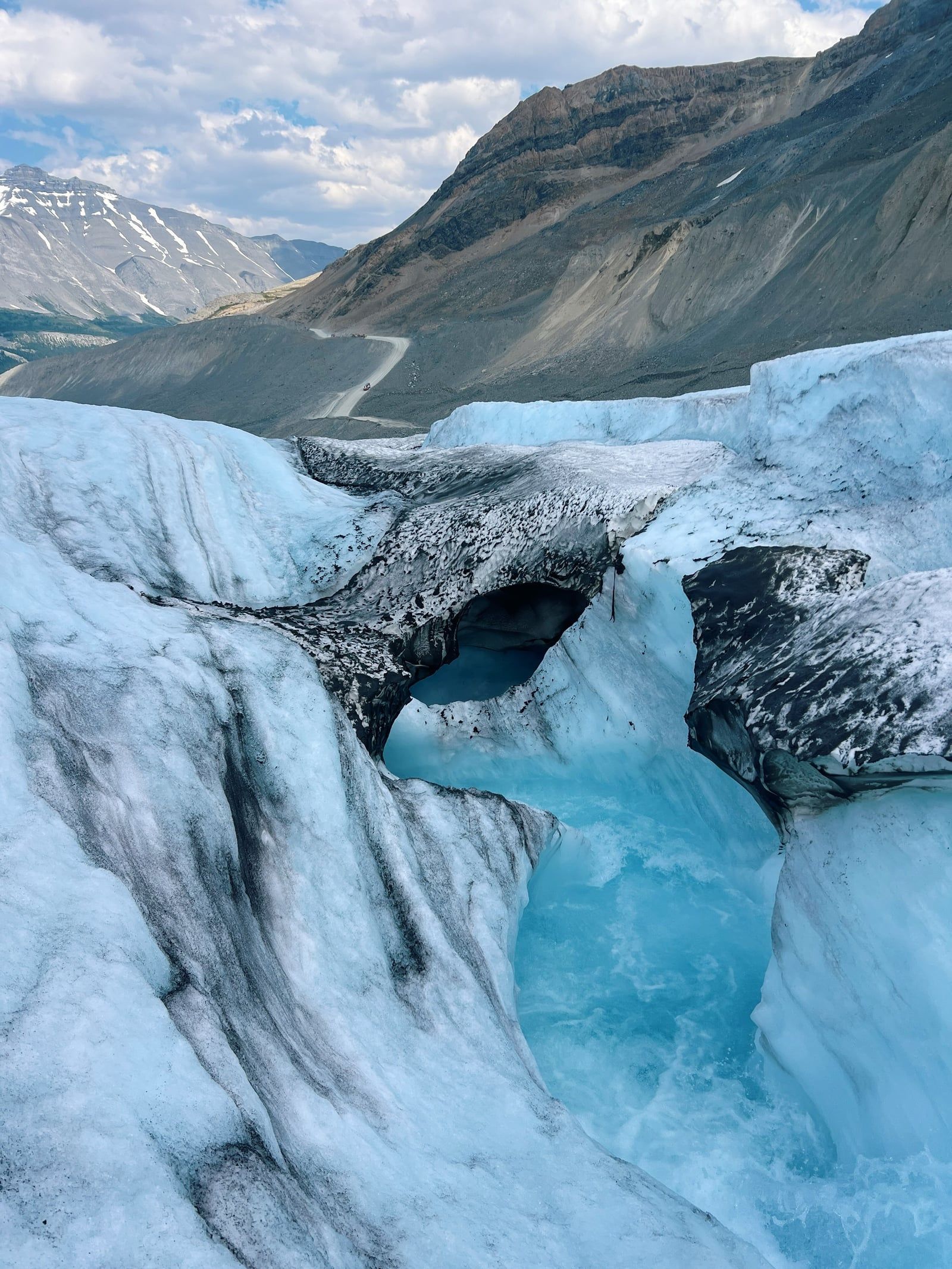
Meltwater from the Columbia Icefield flows into the Pacific, Atlantic, and Arctic oceans.
Visitors ride onto the glacier in massive six-wheel-drive vehicles, which are one of only 23 such machines in the world.
The Athabasca Glacier loses about five metres of depth every year and has lost half its volume since the 1800s.
The surface of the glacier is typically 15 degrees Celsius colder than the nearby Discovery Centre.
Mountain goats and bighorn sheep frequently navigate the sheer limestone cliffs directly below the glass-floored Skywalk.
Mount Columbia, located on the icefield's western edge, is the highest point in Alberta at 3,747 metres.
The glacier contains deep, invisible crevasses covered by snow bridges, making unguided walking extremely dangerous.
Yes. The Columbia Icefield is located inside Jasper National Park. Every adult needs a Parks Canada day pass, which costs $12.25 CAD, or an annual Discovery Pass.
The combined Ice Explorer and Skywalk tour takes 2.5 to 3 hours round-trip from the Discovery Centre. You spend about 15 to 25 minutes actually walking on the Athabasca Glacier.
Walking beyond the marked tourist area without a guide is highly dangerous due to hidden crevasses. Several fatal falls have occurred. To walk safely on the ice, book the guided Columbia Icefield Adventure or hire a certified mountaineering guide.
The tours and the Discovery Centre operate from early May to mid-October. The site shuts down completely during the winter months due to heavy snow and avalanche risk.
Wear warm layers and closed-toe shoes with grippy soles. The temperature on the glacier is significantly colder than in the parking lot, and weather changes rapidly from sun to snow.
The icefield is about 180 kilometres north of Banff. The drive takes roughly two and a half hours via the Trans-Canada Highway and the Icefields Parkway.
Yes. The 800-metre Skywalk loop is completely flat and accessible for wheelchairs and strollers. The Ice Explorer tours also have two vehicles with wheelchair lifts, but you must book these by phone 72 hours in advance.
Skywalk-only tickets start around $41 CAD for adults. The combined Ice Explorer and Skywalk package starts at $109 CAD, with prices increasing based on demand and proximity to the date.
There are no washrooms on the glacier or at the Skywalk. You must use the facilities at the Glacier Discovery Centre before boarding your tour bus.
Pets are not allowed on the Ice Explorer buses, the glacier, or the Skywalk. Only accredited service dogs are permitted on the tours.
Browse verified tours with free cancellation and instant confirmation.
Find Tours